
Short answer: it’s the sun. If your once-crisp epoxy floor has faded to an uneven, dingy yellow, the culprit is almost always UV radiation, from sunlight pouring through a window or garage door, and sometimes from interior lighting. The UV breaks down the resin at the molecular level, and here’s the hard truth: once it turns, it’s permanent. You can’t clean it off or buff it out.
The good news is that yellowing is completely preventable when the floor is built right from the start. Let’s break down why epoxy yellows, why it can’t be reversed, and exactly how to keep it from ever happening to your floor.
Why Do Epoxy Floors Turn Yellow?
Yellowing, sometimes called ambering, is a chemical reaction, not dirt and not a cleaning problem. A few things drive it, but one towers over the rest.
UV Radiation: The Main Culprit
This is the big one, responsible for the vast majority of yellowed floors we see. When ultraviolet light hits standard epoxy, it attacks the polymer chains and kicks off a process called photodegradation. The reaction forms new molecular structures called carbonyl groups that carry a yellow or amber tint. In plain terms, the sun rearranges the epoxy’s chemistry and stains it from the inside out.
It doesn’t take a wall of windows, either. A single sunny garage door left open through the afternoon, or a bright band of daylight across one section of floor, is enough to yellow that area while the shaded parts stay lighter. That uneven, blotchy look is a dead giveaway that UV is the cause.
The Resin Itself: Aromatic vs. Aliphatic
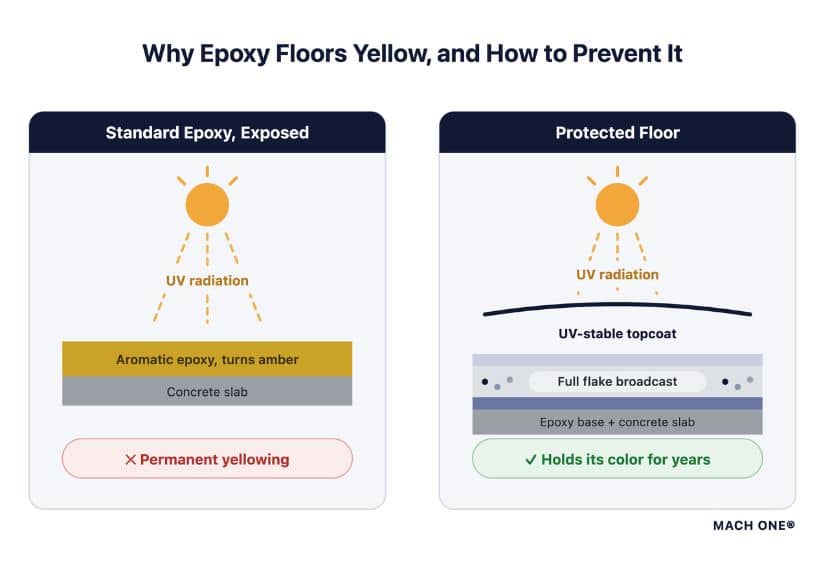
Here’s what most homeowners never get told. Not all epoxy is created equal, and the difference comes down to chemistry. Most standard epoxies are aromatic, built on a molecular backbone that oxidizes fast under UV light. Aromatic epoxy is affordable and bonds beautifully, which makes it a great base coat, but it is simply not UV-stable and will yellow in the sun.
Aliphatic products, like quality polyaspartics, don’t have that vulnerable aromatic ring structure, so they resist UV-induced yellowing and hold their color. This single distinction is why a properly built floor uses the right product in the right place: a strong epoxy base for adhesion, protected by an aliphatic, UV-stable topcoat that takes the sun’s punishment.
Amine Blush During Cure
There’s a second, less common cause worth knowing. During curing, the amine hardeners in epoxy can react with moisture and carbon dioxide in the air to form a waxy film called amine blush, which can look yellowish or hazy. This one isn’t about the sun, it’s about installing in the wrong conditions. It’s prevented by following the manufacturer’s exact mix ratios and controlling temperature and humidity during the install, which is exactly the kind of detail a professional manages and a rushed job ignores.
Is Yellowing Epoxy Reversible?
We’ll be straight with you: no. Because yellowing is a molecular change inside the resin itself, not a surface stain, there is no cleaner, polish, or scrub that reverses it. Once the epoxy has ambered, that color is locked in.
The only real fix for a floor that has already yellowed is to recoat or redo it with a UV-stable system. That’s why prevention matters so much. Getting it right the first time is far cheaper than paying to correct it later, which is a theme in just about everything we do.
How to Prevent Epoxy Floor Yellowing
Preventing yellowing isn’t complicated, but it does require using the right products and not cutting corners. There are two proven ways to protect a floor, and the best systems often use both.
Apply an Aliphatic, UV-Stable Topcoat
The most reliable defense is sealing the floor under an aliphatic, UV-resistant topcoat, typically a polyaspartic. Think of it as sunscreen for your floor. The epoxy base coat does the bonding and building, and the polyaspartic topcoat takes the UV hit without yellowing, keeping the color underneath true for years. Quality UV-stable products are also engineered with light stabilizers that neutralize the UV damage before it can discolor the coating. If a floor is going anywhere near sunlight, this topcoat isn’t optional in our book.
Use a Full Vinyl Flake Broadcast
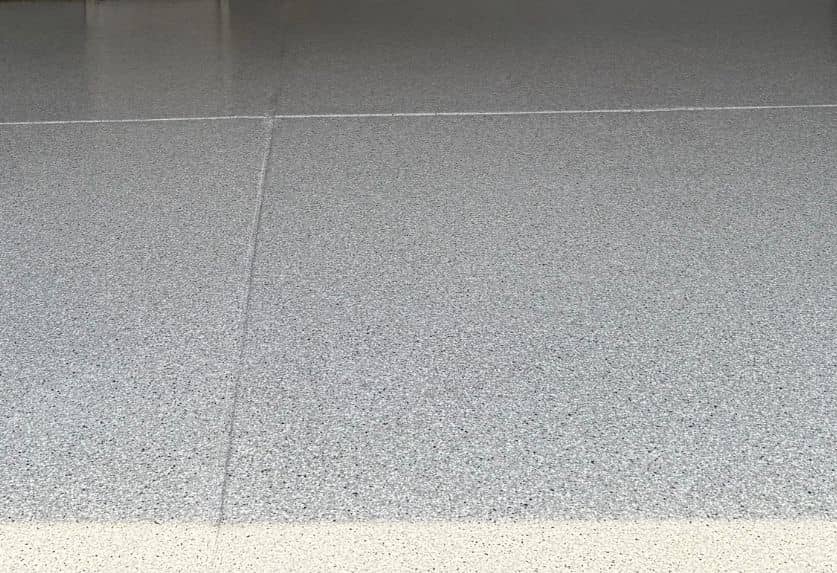
A full flake broadcast is the other strong line of defense, and it’s a favorite for garages because it looks fantastic while it protects. In a full-flake floor, decorative vinyl chips are broadcast to complete saturation across the surface and then sealed under a clear UV-stable topcoat. The flakes themselves are color-stable, and because they cover the surface entirely, they mask and guard the epoxy underneath. You get a durable, great-looking floor and built-in yellowing resistance in one system. Pair a full flake broadcast with a polyaspartic topcoat and you’ve got about the toughest defense against yellowing there is.
What to Do If Your Floor Has Already Turned
If you’re reading this because your floor has already gone yellow, don’t panic, but don’t expect a miracle cleaner either. The move is to have it properly recoated or reinstalled with a UV-stable system. A good installer will assess whether the existing coating is sound enough to recoat over, or whether it needs to come up and start fresh, then rebuild it correctly with an aliphatic topcoat or full flake system so it never happens again.
Just make sure whoever does the work uses UV-stable products this time. Recoating a sun-exposed floor with more standard aromatic epoxy will land you right back here in a year.
The Bottom Line
A yellow epoxy floor isn’t dirty and it isn’t your fault, it’s UV light breaking down a coating that wasn’t built to handle it. The damage is permanent, but it’s also 100 percent preventable with the right system: a quality epoxy base, protected by an aliphatic UV-stable topcoat, a full vinyl flake broadcast, or both.
That’s how we build every floor. MACH ONE® is a veteran-founded franchise, and we bring the same standard to your garage that we brought to our service: use the right products, respect the details, no shortcuts. We seal our floors to hold their color and stand behind our interior work with a warranty, because we install it right the first time. If your floor has already yellowed, or you want to make sure a new one never does, reach out to MACH ONE® near you.
Check Out More Great Posts
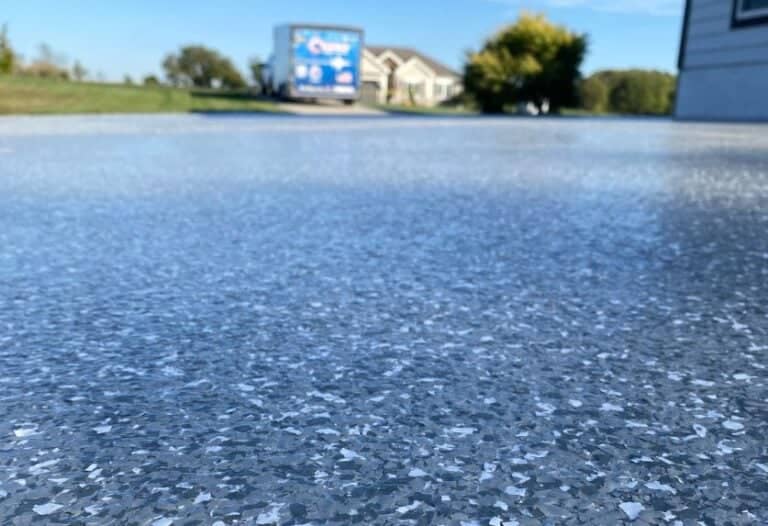
Can You Epoxy a Driveway? What Every Homeowner Should Know
Learn what UV, freeze-thaw, and hot tires do to the wrong concrete coating, and which products actually last outside on a driveway.
Read article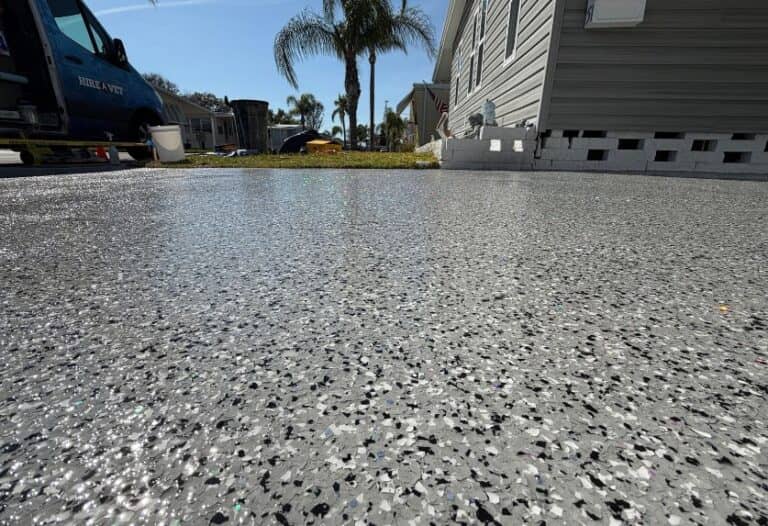
Can You Install Epoxy Flooring in Summer Heat?
Summer heat and humidity change how epoxy cures. Learn the ideal temperature range, common DIY mistakes, and how MACH ONE gets it right.
Read article
Your Guide to Epoxy Flake Floor Colors
From the sleek look of Tuxedo to custom sports team blends, discover how our 1/4" flake systems provide the ultimate balance of professional style and industrial-grade durability.
Read article