

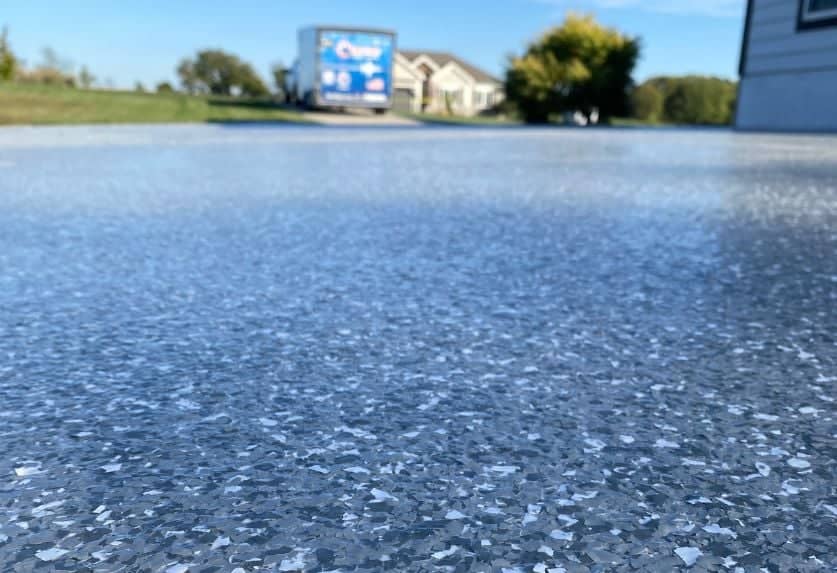
Short answer: technically, yes, you can put epoxy on a driveway. Should you? In most cases, no, at least not standard epoxy on its own. It’s one of the most common questions we hear, usually from homeowners who loved the look of a glossy garage floor and figured the driveway was the natural next step. The instinct makes sense. The product choice is where people get burned.
Here’s the honest version, the same way we’d explain it standing in your driveway. Epoxy is a fantastic coating in the right environment, but a driveway is one of the harshest environments a coating can face. Before you spend a dollar, it’s worth understanding why, and what actually holds up outside.
The Short Answer: Can You Install Epoxy on a Driveway?
You can apply epoxy to an exterior concrete driveway, but in most cases, standard epoxy alone is not built to survive there. Epoxy was engineered for interior slabs like garages, basements, and warehouses, where it’s shielded from direct sun, wild temperature swings, and standing water. Move it outdoors and its biggest weaknesses get exposed fast.
That doesn’t mean a driveway or patio can’t be coated beautifully. It absolutely can. It just means the coating system has to be chosen for the outdoor reality, not borrowed from an indoor floor. The difference between a driveway that looks great for years and one that peels within a season comes down almost entirely to using the right products and prepping the concrete correctly.
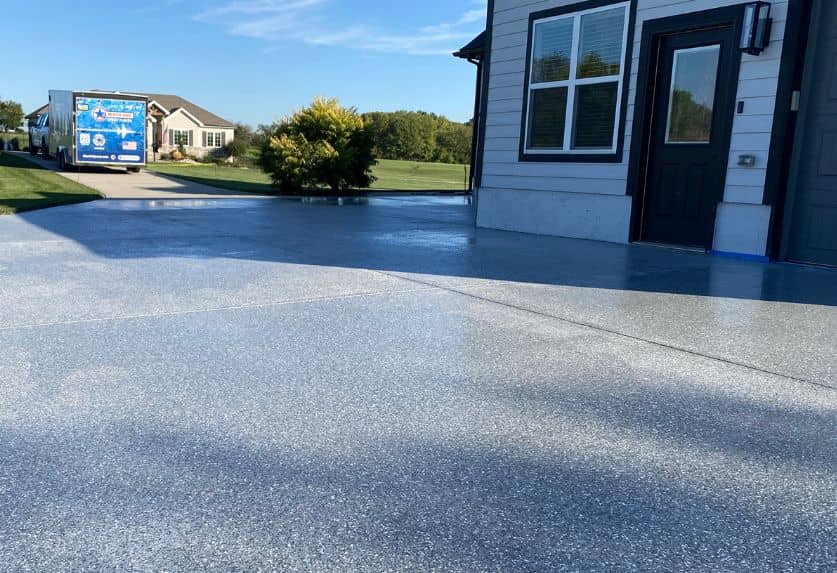
Why Standard Epoxy Struggles Outdoors
A driveway takes a beating that a garage floor never sees. Sun all day, freezing nights, rain, snow, road salt, and the full weight of vehicles turning and braking on it. Standard epoxy has four specific weaknesses that this environment attacks directly.
UV Exposure and Yellowing
This is the big one. Epoxy is not UV-stable. Under direct sunlight, it begins to photodegrade, and most standard epoxies start to yellow, chalk, and lose their gloss within 6 to 12 months. What looked like a crisp, clean finish in spring can turn into a dull, discolored, uneven surface by the next summer. No amount of quality installation changes this, because it’s a chemical limitation of the material itself.
Freeze-Thaw and Cracking
Concrete moves. In any climate with real winters, water works into the slab, freezes, expands, and thaws over and over. A rigid coating like epoxy does not flex with that movement. Instead it grows brittle in the cold and cracks, and once the surface cracks, water gets underneath and accelerates the failure. Flexibility matters enormously outdoors, and hard epoxy simply doesn’t have it.
Hot Tire Pickup and Heavy Traffic
Driveways carry the same hot-tire threat that plagues garage floors, and then some. When tires heat up from driving, the chemicals that keep rubber flexible soften certain coatings and literally lift them off the concrete, a failure known as hot tire pickup. Add the constant turning, stopping, and point loading from vehicle weight, and a coating that isn’t tough and well-bonded doesn’t stand a chance.
Moisture and Adhesion
Outdoor slabs deal with far more water than indoor ones, both from above and from moisture vapor moving up through the concrete from the ground. When that vapor hits an impermeable coating that wasn’t installed over a properly prepared, moisture-managed surface, it gets trapped, builds pressure, and pushes the coating off in blisters and peels. This is exactly why cutting corners on prep, like pressure washing or acid washing instead of mechanically grinding, guarantees failure outdoors.
What Driveway Coatings Work: Polyaspartic and Polyurea Systems
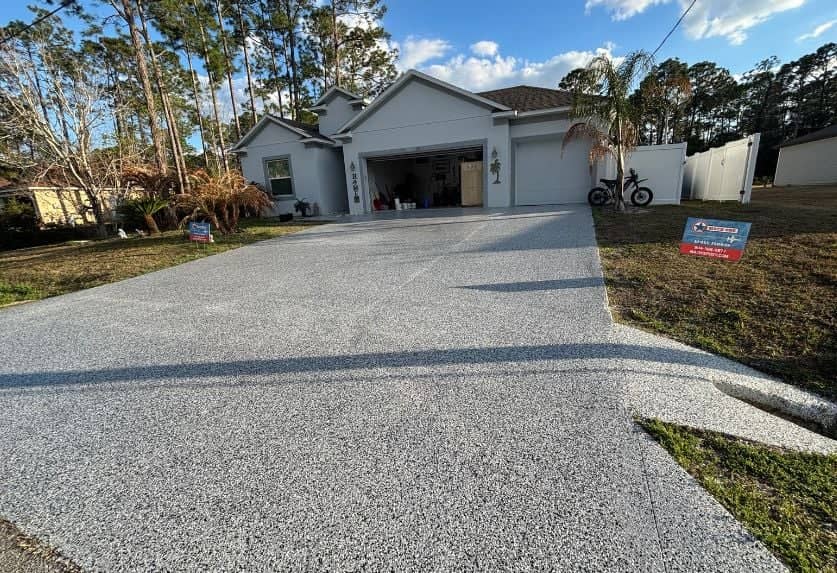
Here’s the good news. The coatings industry solved the outdoor problem, just not with plain epoxy. Polyaspartic and polyurea coatings are the right tools for exterior concrete. They’re UV-stable, so they won’t yellow or fade in the sun. They stay flexible, so they move with the slab through freeze-thaw cycles instead of cracking. They’re extremely durable against traffic and abrasion, and they cure fast enough to get you back on the surface quickly.
In practice, the strongest driveway systems pair a high-adhesion base with a UV-stable polyaspartic topcoat, often with a decorative flake or a slip-resistant broadcast built in for traction, since a smooth coating can get slick when wet. This is the same family of high-performance coatings used on garage floors, tuned specifically for the demands of the outdoors.
What a Proper Driveway Coating Looks Like
If you do coat a driveway, the process is what separates a lasting result from a quick failure. It starts with mechanical preparation, diamond grinding or shot blasting the concrete to open up the surface so the coating can bond deep into the slab. No shortcuts, no acid etching, no pressure-wash-and-pray.
From there, cracks and spalls get repaired, a base coat goes down for adhesion and build, any decorative flake or slip-resistant aggregate is broadcast in, and a UV-stable polyaspartic topcoat seals it all and protects the color. Done correctly, on sound concrete, in the right conditions, an exterior system like this can look excellent and perform well for years.
Cost and Lifespan of Driveway Coatings: What to Expect
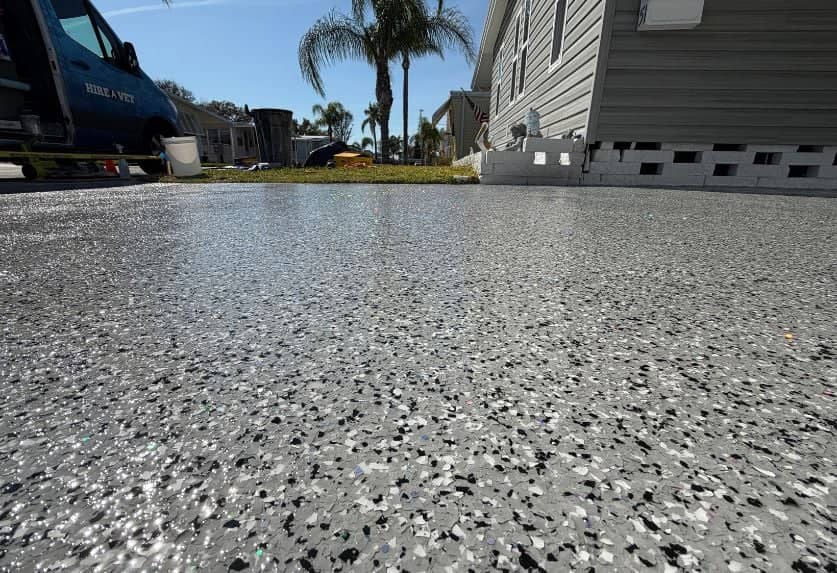
Coating a driveway costs more per square foot than coating a garage, because exterior systems require UV-stable materials and often an extra weather-resistant coat. As a general range, professional exterior coating systems tend to run higher than what you’d see on an interior polyaspartic floor, and driveways are large surfaces, so the total is a real investment.
Lifespan outdoors depends heavily on climate, sun exposure, slab condition, and how the surface is used and maintained. Even with the right products and flawless installation, an outdoor coating lives a harder life than an indoor one, and it will show wear sooner. That’s simply the reality of the environment, and any honest contractor will tell you the same.
How to Choose the Driveway Coating Contractor
Two things separate a smart driveway coating decision from a regret. First, insist on the right products. If a contractor proposes standard epoxy for an exterior driveway, that’s a red flag. You want a UV-stable polyaspartic or polyurea system, installed over properly ground and prepped concrete.
Second, be cautious about warranties. This matters, so we’ll be blunt about it. A driveway faces so many variables outside anyone’s control, weather, freeze-thaw, sun, salt, water, and constant vehicle traffic, that no coating can be guaranteed the way an interior garage floor can. Plenty of companies will still hand you an impressive-sounding warranty on a driveway and then bury exclusions for UV damage, moisture, hot tire marks, and cracking, which covers essentially everything that actually goes wrong outdoors. A warranty full of exclusions isn’t protection, it’s marketing.
The Bottom Line
Can you epoxy a driveway? Technically yes, but standard epoxy is the wrong product for the job and will likely disappoint you within a year. If you want to coat your driveway, do it with UV-stable polyaspartic or polyurea products over properly prepared concrete, go in with realistic expectations about lifespan, and work with a contractor honest enough to tell you what a driveway coating can and can’t promise.
That’s the conversation we’re always glad to have. If you’re weighing a driveway coating, or deciding between the driveway and a fully warranted garage floor, reach out to MACH ONE® and we’ll give you a straight answer about what makes sense for your home, your climate, and your budget.
Check Out More Great Posts
Epoxy Floor Horror Stories: 7 Nightmares That Could Haunt Your Garage
Peeling, bubbling, yellowing, hot tire pickup, and more: here are seven epoxy floor horror stories, what causes each one, and how to keep them out of your garage.
Read article
Why Is My Epoxy Floor Turning Yellow?
Is your epoxy floor fading to an ugly yellow? It's UV light breaking down the resin, it's permanent, and here's exactly how to prevent it.
Read article
Can You Install Epoxy Flooring in Summer Heat?
Summer heat and humidity change how epoxy cures. Learn the ideal temperature range, common DIY mistakes, and how MACH ONE gets it right.
Read article