

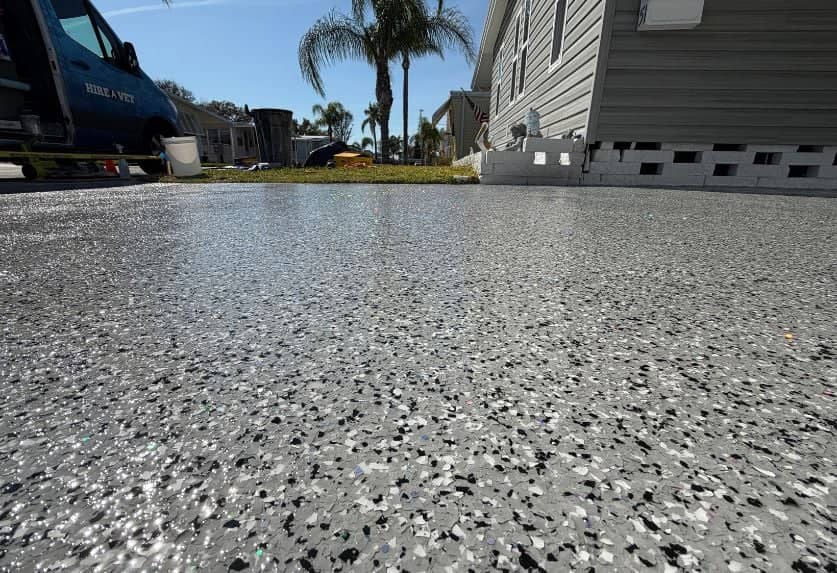
Summer is prime time for garage makeovers, patio upgrades, and pool deck projects, but if temperatures in your area are climbing into the 90s, you might be wondering if it’s too hot to install epoxy flooring. The short answer: yes, you can install epoxy in summer, but heat and humidity change how the material behaves, and getting it wrong can mean a weaker, uneven, or short-lived floor.
Here’s what’s actually happening beneath the surface, and how professional installers work around the heat to get it right.
1. Heat Speeds Up the Clock
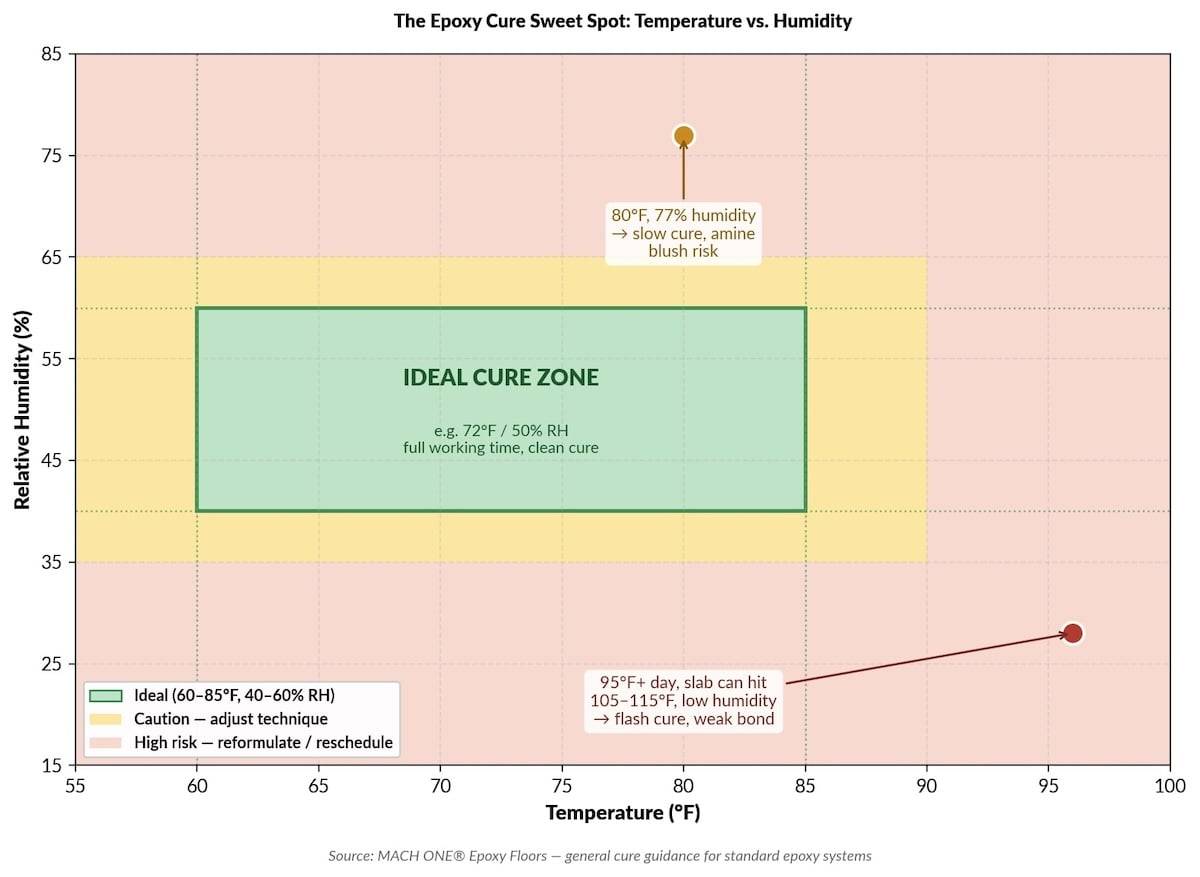
Epoxy properties differ from paint. With epoxy installation, a chemical reaction occurs with two components that cure through their own heat-generating process. Most systems are built to perform best between 60°F and 85°F. Push past 90°F and that reaction speeds up fast.
That sounds like a good thing. It’s not. A faster cure means a shorter window to spread, level, and broadcast flake before the material starts to gel. Rush that window and you’re looking at roller marks, an uneven finish, or air bubbles trapped under a surface that skinned over before it could breathe.
2. Humidity Is the Sneaky Variable
Temperature gets the blame, but humidity does just as much damage. The target range is 40% to 60%.
Too dry, and the epoxy cures too fast, weakening the bond to the slab. Too humid, and it cures too slow, sometimes leaving a hazy, amine-blush finish behind.
Summer doesn’t hold still. A dry, scorching afternoon can turn into a humid evening storm in the same day. That swing is exactly why timing the install matters as much as picking the product.
3. What Happens When DIY Meets a 95° Slab
Box-store kits are built for average conditions, not a garage floor baking in direct sun. And that slab runs hotter than the air around it; sometimes 10 to 20 degrees hotter.
Try to install on that surface without adjusting anything, and here’s what you’re up against: epoxy setting up before it’s spread, bubbling as trapped moisture tries to escape a skinned-over surface, weak adhesion, and a finish that looks decent for a month before it starts to peel or yellow.
4. How We Plan Around the Heat
We don’t dodge summer jobs. We plan for them, the same way you’d plan any operation around the weather instead of hoping it cooperates. That means:
- Working early. Morning installs beat the peak slab and air temps.
- Reading the slab, not just the forecast. If we are concerned about surface temperature, we may check it with an infrared thermometer. Surface temperature is what actually drives the cure; not the number on your weather app.
- Adjusting the mix. Professional-grade epoxy and polyaspartic coatings can run slower-curing hardeners to buy back working time in the heat.
- Controlling the air. Fans and air movers keep conditions steady during application.
- Testing for moisture. A calcium chloride or humidity probe test checks what’s coming up through the slab before we ever open a bucket.
None of that is guesswork. It’s prep; the same “do it right the first time” standard we bring to every job.
The Verdict
Summer heat doesn’t rule out an epoxy install. It just rules out cutting corners. With the right crew reading the slab, adjusting the materials, and working the clock instead of against it, your concrete floor cures the way it’s supposed to, no matter what the thermometer says.
At MACH ONE® Epoxy Floors, we bring the same Service, Integrity, and Pride to every job, hot or not. Ready to get your garage, patio, or pool deck done this summer? Contact a location near you to request a quote.
Check Out More Great Posts
Epoxy Floor Horror Stories: 7 Nightmares That Could Haunt Your Garage
Peeling, bubbling, yellowing, hot tire pickup, and more: here are seven epoxy floor horror stories, what causes each one, and how to keep them out of your garage.
Read article
Can You Epoxy a Driveway? What Every Homeowner Should Know
Learn what UV, freeze-thaw, and hot tires do to the wrong concrete coating, and which products actually last outside on a driveway.
Read article
Why Is My Epoxy Floor Turning Yellow?
Is your epoxy floor fading to an ugly yellow? It's UV light breaking down the resin, it's permanent, and here's exactly how to prevent it.
Read article