

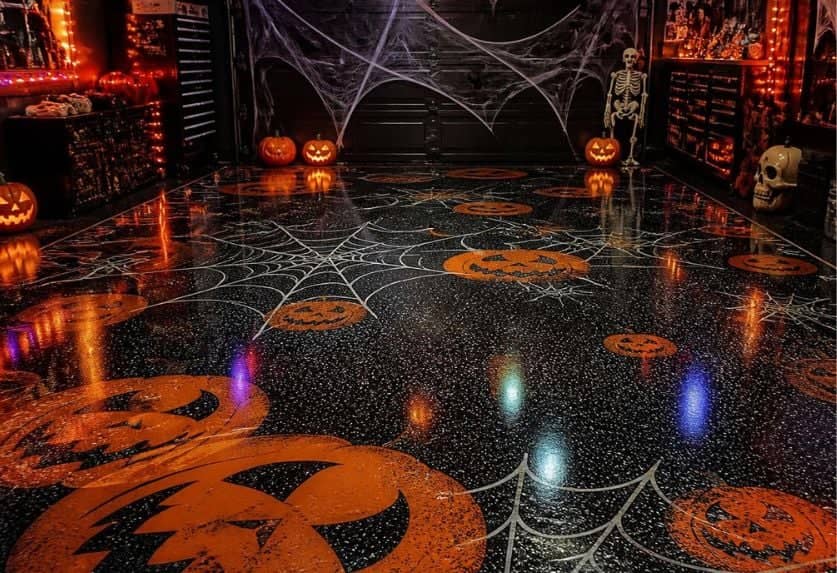
Every October the scary stories come out. But for a lot of homeowners, the real nightmare isn’t hiding in the closet. It’s spreading across the garage floor. A good epoxy floor is one of the best upgrades you can make. A bad one turns into a peeling, bubbling, yellowing mess that haunts you for years and costs real money to rip out and redo.
Here’s the good news. We’ve seen every one of these failures up close, and every single one is preventable. Grab a flashlight and walk with us through seven epoxy floor horror stories, what causes each one, and how to keep it out of your garage for good.
The 7 Scariest Epoxy Floor Problems
Epoxy floor problems aren’t bad luck. They’re the predictable result of skipped prep, cheap products, and corners cut to save a buck. These are the seven failures we get called out to fix most often, what causes each one, and how to make sure it never happens to you.
1. The Peeling Epoxy Nightmare
You wake up one morning and the coating is lifting off the concrete in sheets, like a shed snakeskin. This is the most common epoxy failure of all, and it almost always traces back to one villain: bad surface preparation. Studies of coating failures point to improper prep as the cause of the overwhelming majority of them.
Here’s the truth. Epoxy needs a rough, open surface to grip. Skip the mechanical grinding and paint over smooth, sealed concrete, and the coating never truly bonds. It sits on top like a sticker until it peels right off. The fix is simple and non-negotiable: the concrete gets diamond ground or shot blasted to the proper profile before a drop of coating goes down. We don’t take shortcuts on prep, and neither should anyone you hire.
2. The Acid-Wash Curse
An installer shows up, splashes some acid on the concrete, hoses it off, and starts coating. A year later, the whole floor fails. This is the acid-etch curse, and it’s one we get called to fix constantly.
Acid etching is a relic of the past. It can lightly clean a surface, but it cannot reliably or evenly profile concrete the way grinding does, and it does nothing to remove oil, grease, paint, or other contaminants that block adhesion. It can also damage landscaping and corrode metal nearby. When you hear “we prepped it by acid washing” or “we just pressure washed it,” you’re hearing the opening line of a horror story. Real preparation is mechanical, not chemical.
3. Attack of the Hot Tire Pickup
Your floor looks perfect, until you pull the car in on a hot day. A few hours later, the coating peels up in patches shaped exactly like your tires. This is hot tire pickup, and it’s one of the sneakiest failures out there.
When tires heat up on the road, the plasticizers that keep rubber flexible leach out and soften weak coatings, letting the hot tire grab the floor and lift it as it cools. Thin, low-solids coatings don’t stand a chance. The defense is proper prep and a high-solids professional system built to take the abuse. Cheap floors fail this test every time. Ours are built to pass it.
4. Epoxy Floor Bubbles and Moisture Blisters
Blisters and bubbles rise up across the floor like something trying to escape from underneath. In a way, something is: moisture. Concrete slabs sit on the ground, and moisture vapor constantly moves up through them. When that vapor hits an impermeable coating installed over a slab that wasn’t tested or prepped for it, the vapor gets trapped, pressure builds, and the coating bubbles and delaminates.
This nightmare is why professionals check for moisture before coating and prepare the surface correctly to manage it. Skip that step and you’re building a floor on top of a problem that will eventually push its way to the surface.
5. The Big-Box DIY Epoxy Kit Fail
A boxed epoxy kit from the hardware store seems like such a deal and being able to install it in one weekend is the cherry on top. Six months later it’s peeling, dull, and lifting under the tires. The big-box kit trap catches thousands of hopeful homeowners every year.
Most of those kits are thin, low-solids, often water-based products, some barely more than tinted paint with a little epoxy added for the label. They lack the film build and toughness to survive a real garage, and they almost never include the diamond grinding step that adhesion depends on. DIY kits have failure rates high enough that many pros make a good living just tearing them out and starting over. If it comes in a small box and promises a weekend miracle, be afraid.
6. Epoxy Yellowing and UV Damage
The floor went in looking crisp, and now it’s an ugly, uneven yellow. It didn’t peel, it didn’t bubble, it just… turned. This is UV degradation, and it’s what happens when epoxy is left exposed to sunlight without the right protection.
Epoxy on its own is not UV-stable. Under sun from a window or an open garage door, it yellows, chalks, and loses its gloss over time. The way to keep a floor’s color true is a UV-stable polyaspartic topcoat sealing the system. Without that shield, sunlight slowly turns your bright new floor into a dingy ghost of itself.
7. The Check Epoxy Contractor
The scariest monster of all doesn’t live in the concrete. It drives away in an unmarked truck with your deposit. The fly-by-night contractor underbids everyone, rushes the prep, uses cheap materials, and vanishes the moment the floor starts to fail, leaving you with no recourse and a mess to pay someone else to fix.
Cutting corners always comes back to haunt someone, and it’s usually the homeowner. Protect yourself. Hire an established, insured installer who grinds the concrete properly, uses professional-grade products, walks you through the whole system, and stands behind their interior work with a real warranty. When a price seems too good to be true, that’s usually the first line of the horror story.
How to Keep Your Garage Flooring Nightmare-Free
See the pattern? Every one of these stories starts with skipped prep, cheap products, or corners cut to save a buck. Do it right and none of them can touch you. That means mechanically grinding or shot blasting the concrete, checking for moisture, repairing cracks, using professional-grade coatings, and sealing everything under a UV-stable topcoat. And it means hiring someone who does this for a living and puts their name behind the work.
That’s where we come in. MACH ONE® is a veteran-led franchise, and we bring the same standards to your garage that we brought to our service: do it right, own the details, no shortcuts. Avoiding these nightmares isn’t luck for us, it’s the standard. We grind every floor properly, we use high-performance products, and we back our garage floors with a warranty because we install them right the first time. If an old epoxy job is already haunting your garage, or you just want to make sure your next one never does, reach out to MACH ONE® near you for a straight answer and a floor built to last.
This Halloween, keep the scares on the porch and off your garage floor.
Check Out More Great Posts
Can You Epoxy a Driveway? What Every Homeowner Should Know
Learn what UV, freeze-thaw, and hot tires do to the wrong concrete coating, and which products actually last outside on a driveway.
Read article
Why Is My Epoxy Floor Turning Yellow?
Is your epoxy floor fading to an ugly yellow? It's UV light breaking down the resin, it's permanent, and here's exactly how to prevent it.
Read article
Can You Install Epoxy Flooring in Summer Heat?
Summer heat and humidity change how epoxy cures. Learn the ideal temperature range, common DIY mistakes, and how MACH ONE gets it right.
Read article